

Keywords
decentralization
local government
local democracy
reform
How to Cite
Abstract
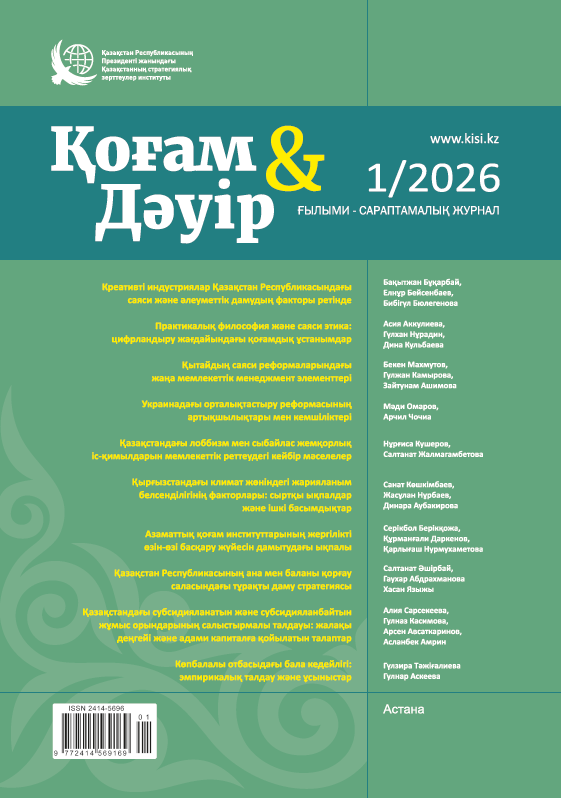
The reform of local self-government and decentralization began in Ukraine in 2014 and is still ongoing. Over the course of 10 years, many of the results of the reform are already becoming noticeable and one can draw a conclusion about its success or failure. The purpose of this article is to analyze the advantages and disadvantages of the Ukrainian decentralization reform, in order to understand whether this model is suitable as a model for other post-Soviet states, including Kazakhstan. An assessment of the advantages and disadvantages of the reform was carried out through in-depth interviews with Ukrainian experts, as well as through SWOT analysis. The main conclusions formulated based on the results of the article are that the Ukrainian decentralization reform has more advantages than disadvantages. The main advantages of the reform are improving the quality of administrative services provided, as well as increasing their accessibility, optimizing the administrative-territorial structure and increasing local budgets. The disadvantages of the reform are the strengthening of regional and local patronage elites, as well as the incompleteness of decentralization at the level of districts and regions. As a result of the article, those elements of the Ukrainian reform were identified that could be used in the conditions of Kazakhstan, with the aim of further developing the system of local self-government.